the president of the German referees supported the guajiro and the controversy grows due to the serious error
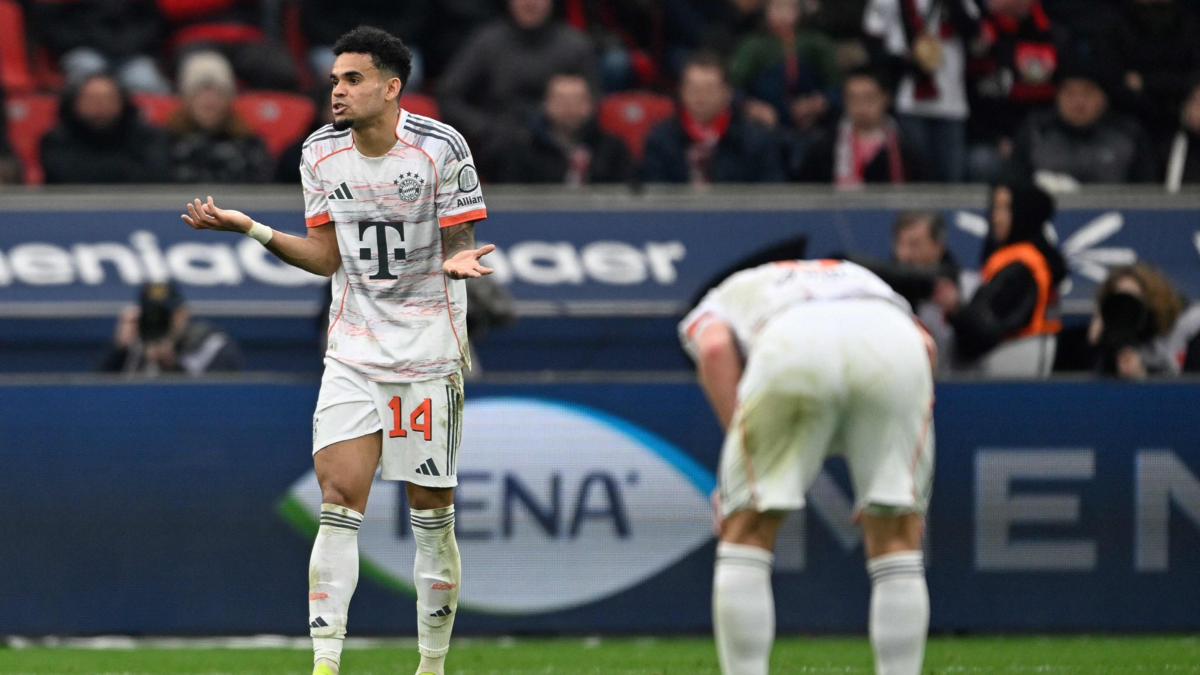
He Bayern Munich this Sunday formalized an appeal before the sports court of the German Football Association (DFB) for the sanction weighing on the Colombian Luis Diaz. The winger was sent off for a double warning during the 1-1 draw against Bayer Leverkusen last Saturday, during a meeting marked by decisions that the collegiate body itself described as “incorrect”. The club’s management acts quickly to ensure that the striker is present during the next Bundesliga matchday.
Rectification of arbitral authorities
The president of the referees commission in Germany, Knut Kircherspoke publicly about the play. In statements to the newspaper Picturestated that “the second yellow card for Díaz was unfortunately incorrect, although from the referee’s point of view it looked like a simulation”. Kircher added that “Christian Dingert rightly admitted his error of judgment.”
Luis Diaz Photo:AFP
For his part, the central arbiter of the engagement, Christian Dingertadmitted his mistake after reviewing the images in the locker room.
“During the match I interpreted the play as a simulation. Looking at the footage it wasn’t a penalty, but the red card was very harsh. Now I wouldn’t take it,” the referee said.
Luis Diaz Photo:EFE
Troubles at Bayern Munich
The Bavarian team management expressed their indignation at the referee’s performance. The technician Vincent Kompanand said he “didn’t understand” why they expelled Luis Diaz. “The red shouldn’t have been red, I can’t say anything to Lucho. There is contact, we can discuss if it’s a penalty but they shouldn’t have sent him off. I can’t say anything to Lucho. He will be fine,” said the Belgian.
Jan Christian Dreesensporting director of the club, confirmed to Aerial sports the appeal procedure and said: “We look at the events of recent weeks with concern. The performance of the refereeing in Leverkusen was the culmination of a period in which we were repeatedly confronted with questionable decisions. The DFB should raise the standard of refereeing.”
Vincent Kompany Photo:EFE
Herbert Hainer, president of Bayern, described the judge’s performance as “total disaster”. “The fact that he admitted that he would no longer give Luis Díaz a card is commendable, but the truth does not help either Luis Díaz or the team,” the coach stressed.
A match of contrasts for Luis Díaz
Guajiro’s performance on the field has had its ups and downs. In the first half, a loss of possession led to the goal of the Bayer Leverkusennoted by Alex Garcia. However, Diaz He managed to redeem himself in the second half by scoring the last equalizing goal with a tight shot after an individual play.
Luis Diaz Photo:AFP
The controversy broke out in the final straight when, after a pass from Harry Kanethe Colombian fell in the area during an argument with the goalkeeper Janis Blaswich. Even if Diaz He stood up immediately without protesting, Dingert interpreted this action as an attempt at deception. Previously, the Colombian had already received a yellow card for a dangerous play when he hit García’s head with his guayo.
Objective: Berlin Union
While the call is in progress, Bayern Munich is hoping for a favorable resolution that will allow Luis Díaz to be present next Saturday in the match against Unión Berlin. The club hopes that the public rectification of the referees’ committee will facilitate the cancellation of the sanction for the 27th day of the German league.
*This content has been rewritten with the help of artificial intelligence, based on information published in previous articles in this media outlet.
PakarPBN
A Private Blog Network (PBN) is a collection of websites that are controlled by a single individual or organization and used primarily to build backlinks to a “money site” in order to influence its ranking in search engines such as Google. The core idea behind a PBN is based on the importance of backlinks in Google’s ranking algorithm. Since Google views backlinks as signals of authority and trust, some website owners attempt to artificially create these signals through a controlled network of sites.
In a typical PBN setup, the owner acquires expired or aged domains that already have existing authority, backlinks, and history. These domains are rebuilt with new content and hosted separately, often using different IP addresses, hosting providers, themes, and ownership details to make them appear unrelated. Within the content published on these sites, links are strategically placed that point to the main website the owner wants to rank higher. By doing this, the owner attempts to pass link equity (also known as “link juice”) from the PBN sites to the target website.
The purpose of a PBN is to give the impression that the target website is naturally earning links from multiple independent sources. If done effectively, this can temporarily improve keyword rankings, increase organic visibility, and drive more traffic from search results.